
Deki Brings Unity-Style 2D Game Engine to ameriDroid Offerings
ESP32 boards have long been the go-to choice for IoT projects, but a new open-source project is proving they can be serious game hardware too. Deki Engine is a free, modular C++ 2D game engine with a Unity-style visual editor, built for embedded devices and currently optimized for ESP32 platforms such as the LilyGO T-Deck Plus, T-Display S3 AMOLED, and soon the Elecrow CrowPanel Advanced 10.1-inch ESP32-P4.

Deki Engine demo running at 60 FPS on a LILYGO T-Display S3 Touch.
What is Deki Engine?
Deki Engine is an open-source modular C++ game engine created by game programmer Jairo Baldán (Jai) from Spain as a side project, and it is free under the Apache 2.0 license. The engine, the editor, and every package live on GitHub, and the editor ships as a download for Windows and Linux with the compiler for the 2D graphics engine included. The project leans heavily on AI assistance, with most commits on GitHub co-authored by Claude, but CNX Software notes it looks like a working project with code quality that is high for a solo, hobby effort. The engine runtime has already pulled in more than 1,600 stars on GitHub.
A Unity-style visual workflow for microcontrollers
The workflow is designed to feel familiar to anyone who has used Unity or Godot:
- Build scenes visually: sprites, text, particles, tilemaps, state machines, and tweens.
- Pick your target board in the editor's Build panel.
- Flash it and play.
- Run the same project on desktop through SDL3, or headless with no renderer at all, which is handy during development.
Inspector fields are generated automatically with C++26 static reflection: fields tagged DEKI_EXPORT are picked up at build time, which gives you sliders, ranges, undo, and serialization from that single tag. The editor, docs, and website are available in English, Simplified Chinese, Japanese, and Korean.

The Deki Engine visual editor, with the scene view and inspector.
60 FPS on an ESP32-S3
Demo footage shows a Deki project running on the T-Display S3 Touch at a smooth 60 FPS, which is impressive for a dual-core microcontroller. The engine also includes a software-rasterized 3D render pass with meshes, a perspective camera, and .obj import that shares one framebuffer with 2D. How smooth that will feel on ESP32 targets remains to be seen, but it is a nice option for retro-style 3D experiments.
Everything is a package
Everything beyond the engine core is a package, and each one is its own repository with its own documentation. Highlights include:
- Hardware packages: LilyGO T-Deck Plus with support for display, touch, keyboard, trackball, SD card, GPS, and LoRa (SX1262), the T-Display S3 AMOLED, and upcoming support for the CrowPanel Advanced 7-inch ESP32-P4. Since the 10.1-inch model we carry is the same platform, with the same ESP32-P4 plus ESP32-C6 chip set and the same 1024x600 IPS panel, it should be a drop-in target as well.
- Gameplay and graphics: deki-2d (sprites, text with bitmap fonts and TTF baking, animations, buttons, scrolling), deki-3d, deki-fsm (PlayMaker-style visual state machines), deki-particles, deki-tween (30+ easing functions), deki-input, and deki-rendering.
- Hardware peripherals: 6-axis IMU (LSM6DS3) with hardware pedometer, RTC (DS3231), I2S audio (MAX98357 class-D amplifier), GPS (NMEA over UART), LoRa (Semtech SX1262 with built-in duty-cycle limit), SD card, Wi-Fi, and BLE.
- Asset pipeline: Tiled Map Editor integration that bakes .tmj files into a streamable binary tilemap.
Deki games can also run as apps inside Tactility, an operating system for ESP32 boards, instead of as firmware that owns the whole device. Recent releases have focused on performance: games draw faster, frames no longer tear, Deki drives many more screens, and the settings configure themselves.
Boards you can play on (at ameriDroid)
If you want to try Deki Engine on real hardware, here are a few ESP32 handhelds we carry that fit the bill.
LILYGO T-Deck Plus
The T-Deck Plus is one of the boards Deki targets out of the box: ESP32-S3 with 16 MB flash and 8 MB PSRAM, a 2.8-inch 320x240 capacitive touchscreen, a physical QWERTY keyboard, trackball, microSD slot, GPS, and SX1262 LoRa. Pick it in the Build panel and the display, touch, keyboard, trackball, SD card, GPS, and LoRa radio all come up. It is exactly the kind of pocket hardware Deki was built for, and ours come in a set of two pre-flashed with Blackout Comms (reflashable to anything, including Deki).
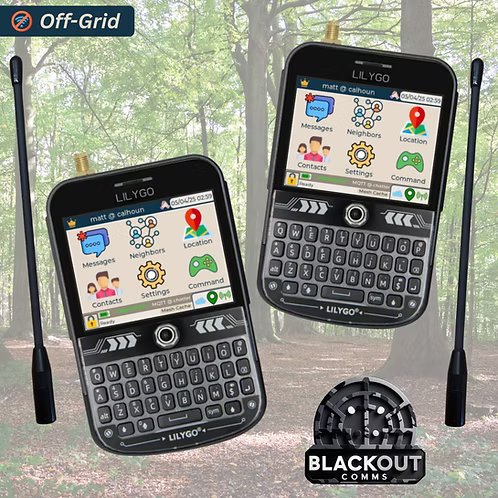
Shop the T-Deck Plus (Set of 2) at ameriDroid: $319.95, on sale from $399.00
LILYGO T-Deck Max
The T-Deck Max is another ESP32-S3 keyboard handheld with a twist: a 3.1-inch front-lit e-paper touchscreen that sips power, plus SX1262 LoRa, 4G LTE, GPS, a QWERTY keyboard, haptic motor, and audio codec. One caveat: e-paper displays refresh far more slowly than LCD or AMOLED panels, so they aren't suited to high-framerate applications. For Deki, that makes the T-Deck Max best for turn-based, menu-driven, or battery-focused games rather than fast 60 FPS action. If you want a Deki game that runs for days on a 1400 mAh battery, a low-refresh e-paper display is a compelling target.
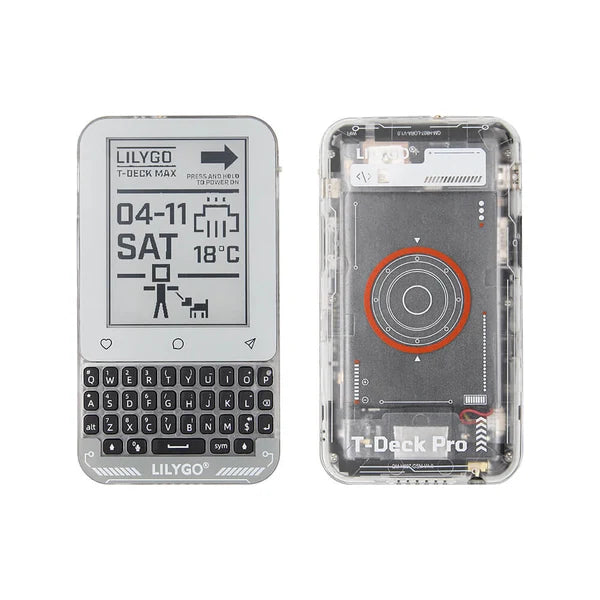
Shop the T-Deck Max at ameriDroid: $149.95
LILYGO T-Display P4
Looking ahead, Deki is adding support for ESP32-P4 hardware, and the T-Display P4 is the most powerful handheld we carry: an ESP32-P4 RISC-V processor (dual-core up to 360 MHz) with an ESP32-C6 Wi-Fi 6 co-processor, a 4.1-inch 568x1232 AMOLED touchscreen, 32 MB of PSRAM, SX1262 LoRa, GPS, a 2MP camera, and a 9-axis IMU. When P4 board support lands, this is the board to push Deki to its limits. If you want a bigger ESP32-P4 screen, we also carry the CrowPanel Advanced 10.1-inch ESP32-P4 HMI display, which shares the same platform as the 7-inch model Deki is targeting.
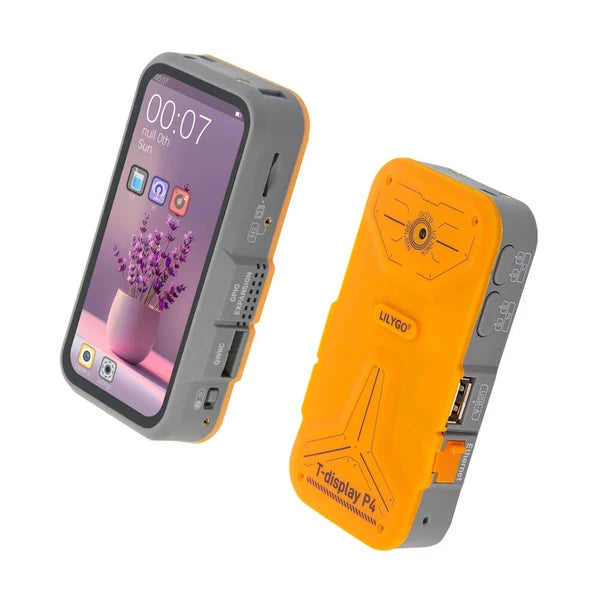
Shop the Lilygo T-Display P4 at ameriDroid: $159.95
Where to learn more
- Deki Engine website and editor download: dekiengine.com
- Package catalog: dekiengine.com/packages
- GitHub (engine, editor, and all packages): github.com/dekiengine
- Original CNX Software coverage: cnx-software.com
With a visual editor, a 60 FPS track record on ESP32-S3, and hardware packages for popular LilyGO boards already in place, Deki Engine is the most complete answer yet to the question of how to make real 2D games on microcontrollers. Grab a T-Deck, flash the demo, and see what a microcontroller can do.